AI Customer Self-Service: How to Build One That Actually Resolves (2026)
Customers want self-service, but most of it fails to resolve anything. Here's how to build AI customer self-service that answers correctly, cites its sources, and hands off cleanly — instead of just deflecting tickets.
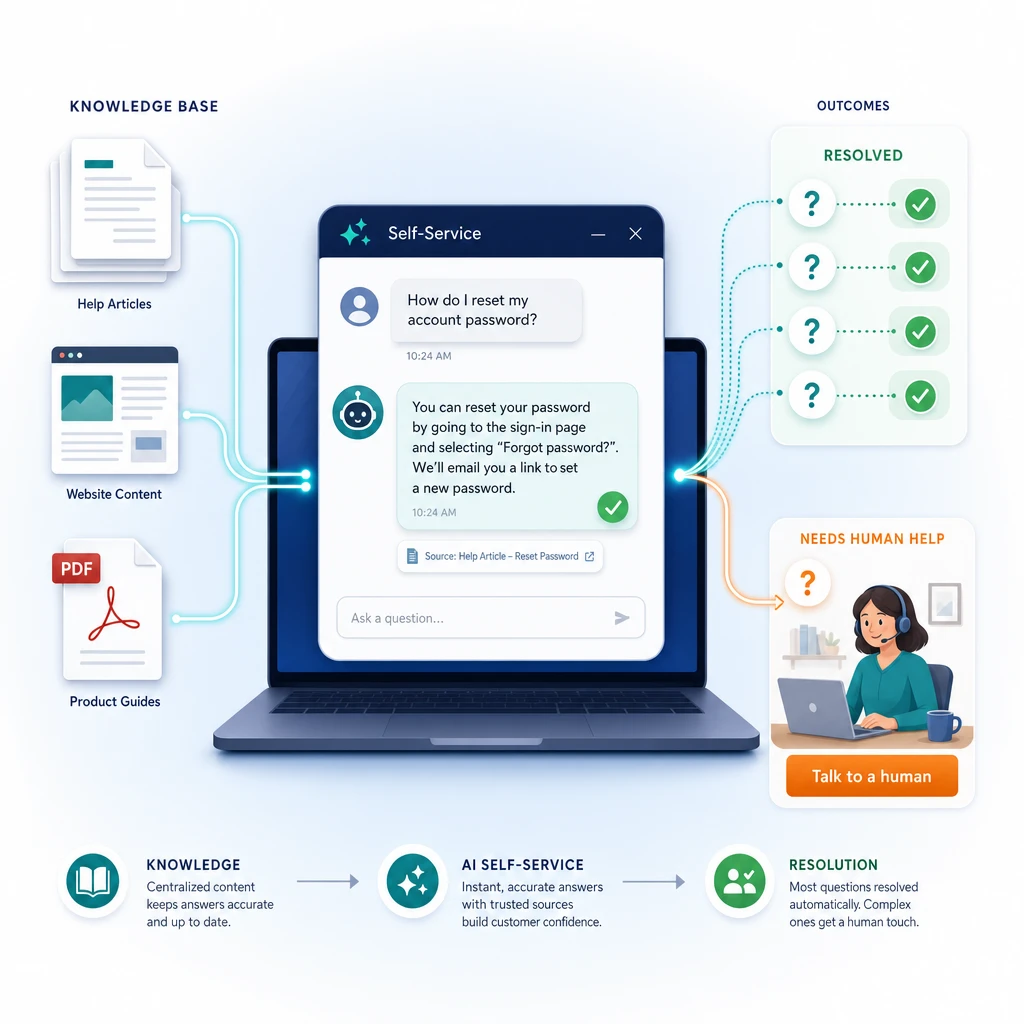
Customers want self-service, and they punish companies that don’t offer it: in a 2025 customer experience study of more than 1,000 U.S. consumers, 34% said they had stopped doing business with a company because self-service options weren’t there (Shep Hyken study, 2025). The problem isn’t demand — it’s that most self-service doesn’t actually resolve anything. Gartner found that only 14% of customer service issues are fully resolved in self-service (Gartner, Aug 2024).
That gap — high demand, low resolution — is the whole game. This guide is about building AI customer self-service that lands in the 14%, not the 86%: a system that answers correctly, shows where the answer came from, and gets out of the way when it can’t help. I’ll be upfront that Owlish is our product and it’s built for exactly this, but the playbook below holds whether or not you ever use it.
Self-service that deflects is not the same as self-service that works
It’s easy to ship a help center or a chatbot, watch your ticket count drop, and call it a win. But a dropped ticket has two possible explanations. Either the customer got their answer, or they gave up. Deflection counts both the same way. Resolution doesn’t.
This is why Gartner’s 14% number is so uncomfortable. Plenty of companies report healthy “deflection rates” while most of the people hitting their self-service walk away unhelped — and a meaningful share of those quietly stop buying. (If you want to get precise about the difference between deflection and resolution, we wrote a realistic 2026 benchmark for ticket deflection that pulls them apart.)
So the bar for AI customer self-service isn’t “did the ticket disappear.” It’s “did the customer leave with the right answer, and did the few who couldn’t be helped reach a human without friction.” Everything below optimizes for that.
Why self-service is becoming the front door, not the fallback
Self-service used to be the channel you pushed people toward to save money. It’s becoming the channel they expect by default.
- Gartner projects that self-service and live chat will surpass traditional channels like phone and email as the most valuable customer service technologies by 2027 (Gartner, Aug 2025).
- 74% of consumers now expect customer service to be available 24/7, per Zendesk’s 2026 CX Trends research (Zendesk, 2026). No human team covers every hour; a self-service layer is the only practical way to meet that.
- 91% of customer service leaders say they’re under pressure to implement AI in 2026 (Gartner, Feb 2026).
The pressure is real and the demand is real. The risk is shipping the kind of self-service that explains the 14% statistic — a bot that confidently makes things up, or a search box that returns ten articles and answers none of the question.
The anatomy of self-service that resolves
A self-service experience that actually closes the loop has four parts. Skip any one and you’re back in the 86%.
1. A knowledge base good enough to answer from
AI self-service is only as good as what it can read. Gartner notes that a large share of self-service failures trace back to irrelevant content and poor findability, not missing intent. Your content has to be correct, current, and complete enough to answer the questions people actually ask — in their words, not your internal vocabulary.
The practical move is to ground the agent in your real sources: your help center, your website, your policy PDFs, your product docs. Then run a knowledge base gap analysis so you’re fixing the questions customers ask, not the articles that were easy to write.
2. Answers, not search results
The difference between a 2015 self-service portal and a 2026 one is that the old one made the customer do the synthesis. A search box hands you ten links; the customer reads, cross-references, and gives up. A grounded AI agent reads your sources and returns the specific answer to the specific question — “Yes, you can return an opened item within 30 days if it’s unworn; here’s the form” — instead of a list of pages that might contain it.
3. Citations, so the answer is verifiable
The single biggest reason AI self-service fails is the same reason people distrust it: it makes things up. The fix is to make every answer traceable to a source. When the agent shows the article or page it pulled from, three things happen at once: the customer can verify it, your team can audit it, and the agent has a built-in reason to refuse when it has no supporting source instead of inventing one. We’ve argued before that grounded answers with citations aren’t a nice-to-have — they’re the line between self-service that resolves and self-service that erodes trust.
4. A clean handoff for the questions it shouldn’t answer
No self-service layer should resolve everything, and trying to is how trust dies. Account-specific issues, refunds past policy, anything emotionally charged, anything where a wrong answer is expensive — those should route to a human. The handoff has to carry context so the customer doesn’t repeat themselves; Zendesk’s 2026 research found that 74% of consumers are frustrated when they have to repeat information to a new agent. A good handoff passes the conversation, the question, and what the agent already tried. (Our AI support handoff playbook covers exactly when a bot should escalate and what to pass.)
What to put in self-service, and what to route to a human
A useful rule of thumb: self-service owns the repetitive, low-risk, knowable questions. Humans own the specific, high-risk, or judgment-call ones. Here’s the split most support teams land on.
| Resolve in self-service | Route to a human |
|---|---|
| Policy questions (returns, shipping, hours) | Account-specific actions and exceptions |
| ”How do I…” product and setup questions | Refunds or credits outside stated policy |
| Order status and tracking lookups | Billing disputes and chargebacks |
| Plan, pricing, and feature questions | Anything emotional, urgent, or a complaint |
| Troubleshooting with documented steps | Anything where a wrong answer is costly |
The boundary isn’t fixed — as your knowledge base improves, the left column grows. But the discipline is to start narrow and expand on evidence, not to point the bot at everything on day one and hope. When you need to classify an individual request before choosing an AI answer, staffed chat, or an after-hours human route, use our AI chatbot vs live chat support routing framework.
The mistakes that keep self-service stuck at 14%
Most failed self-service projects share the same handful of root causes. Watch for these:
- Optimizing deflection instead of resolution. If your only metric is “tickets avoided,” you’ll reward a bot that drives people away as much as one that helps them. Track resolution and escalation quality alongside deflection.
- Letting the bot guess. An agent with no citation discipline will fill silence with plausible nonsense. A confidently wrong answer is worse than “I don’t know — let me get a person,” because the customer acts on it.
- Stale content. Self-service degrades silently. A return policy changed in a Slack thread but never in the help center becomes a wrong answer the AI repeats at scale.
- A dead-end when it fails. If the bot can’t help and there’s no obvious path to a human, you’ve converted a support question into a churn risk. The exit has to be one click, with context attached.
- Hiding it. Gartner found that 60% of customer service agents fail to promote self-service to customers (Gartner, June 2025). The best self-service in the world doesn’t help if customers never find it. Surface it in the widget, in confirmation emails, and at the moments people get stuck.
For a fuller list, our writeup on customer support chatbot mistakes to fix before launch goes deeper.
How to measure whether it’s working
Resolution is the headline metric, but it’s not the only one worth a dashboard. A balanced view of AI customer self-service tracks:
- Self-service resolution rate — the share of self-service sessions that ended with the customer’s answer, not a giveaway or a silent exit. This is the number to obsess over.
- Escalation rate and escalation quality — how often the bot hands off, and whether those handoffs are appropriate (a bot that never escalates is hiding failures; one that always escalates isn’t doing its job).
- Containment vs. CSAT together — never read deflection without a satisfaction signal next to it. High containment with falling CSAT means you’re deflecting, not resolving.
- Top unresolved questions — your agent’s refusal and escalation log is a free, ranked list of what your knowledge base is missing. Feed it back into content.
If you want the broader metric set, see our guide to the AI customer service metrics that matter.
Where Owlish fits
Owlish is a no-code platform for building exactly the kind of self-service layer described above. You point it at your knowledge — websites, PDFs, documents, help center — and it builds an AI agent that answers customer questions in a web widget, grounded in those sources, with citations on its answers so every reply is verifiable. When it hits something it shouldn’t handle, it hands off to a human operator with the conversation context attached. Pricing is flat and session-based rather than per-resolution, so a self-service layer that gets better at resolving doesn’t cost you more each time it succeeds: there’s a free tier, then Starter at $49/mo ($39/mo billed annually), Growth at $149/mo ($119/mo annually), and Scale at $449/mo ($359/mo annually) — roughly 20% off on annual billing.
Owlish is a good fit if you’re a small or growing support team that wants self-service that resolves and cites its sources, without a per-resolution meter or an engineering project. It’s not a full ecommerce helpdesk with native order management, and it’s not a replacement for a large enterprise contact-center suite with telephony and deep workforce routing. If you need those, a platform like Zendesk or a dedicated ecommerce desk is the better home, and you can still run a grounded agent in front of it. The honest pitch is narrow: Owlish is for getting accurate, cited, 24/7 answers in front of customers and handing the rest to a person cleanly.
A practical rollout checklist
- Pick the top 20 questions from your ticket and chat history. Those are your launch scope.
- Ground the agent in the real sources that answer them — help center, website, policy docs.
- Turn on citations and verify a sample of answers against the cited source.
- Set the handoff rules before launch: which questions route to a human, and what context goes with them.
- Launch narrow, to the top questions, not everything.
- Read the escalation log weekly and close the highest-frequency gaps.
- Watch resolution and CSAT together — and expand scope only as the evidence supports it.
Frequently asked questions
What is AI customer self-service? It’s letting customers get answers on their own — through a chat widget, help center, or portal — powered by an AI agent that reads your knowledge base and responds to questions directly, around the clock. Done well, it resolves repetitive, low-risk questions instantly and routes the rest to a human. The key word is resolve: deflecting a ticket isn’t the same as answering the customer.
Why does most self-service fail to resolve issues? Gartner found only 14% of issues are fully resolved in self-service, largely because of irrelevant or outdated content, poor findability, and tools that return search results instead of answers. AI agents help only if they’re grounded in correct, current sources and built to refuse rather than guess when they can’t answer.
Will AI self-service replace human support agents? No — it changes what humans spend time on. Self-service should own the repetitive, knowable questions so people can focus on account-specific, high-risk, and emotional issues where judgment matters. The goal is a clean division of labor with a fast handoff, not removing humans.
How do I stop an AI self-service agent from giving wrong answers? Ground it in your real knowledge base, require citations on every answer, and configure it to say “I don’t know — let me get a person” instead of inventing a response. A confidently wrong answer is worse than an honest refusal, because the customer acts on it.
What should I measure for AI customer self-service? Lead with self-service resolution rate, not deflection. Track escalation rate and quality, read containment and CSAT together so you don’t reward driving customers away, and mine the escalation log for the top unresolved questions to feed back into content.
How long does it take to set up AI self-service? With a no-code platform and a reasonable knowledge base, an initial agent scoped to your top questions can be live in a session or two of setup work. The longer effort is the ongoing loop — reviewing escalations and keeping content current — which is where resolution rates actually improve over time.
The takeaway
Self-service isn’t optional anymore; customers expect it and leave when it’s missing. But the thing they leave over isn’t the absence of a chatbot — it’s the presence of one that doesn’t resolve anything. Gartner’s 14% is the cost of building for deflection instead of resolution.
The fix is unglamorous and reliable: ground the agent in correct, current sources; return answers, not search results; cite every answer so it’s verifiable; and hand off cleanly when the question isn’t yours to answer. If you want to build that kind of self-service layer — grounded, cited, with a one-click path to a human — you can build an agent on Owlish, point it at your content, and let the escalation log tell you what to fix next.
Sources cited above were checked in June 2026. Gartner, Zendesk, and the Shep Hyken consumer study statistics link to their publications; figures may be updated by their publishers over time.