How to Reduce First Response Time in Customer Support (2026 Playbook)
Customers judge your support by how fast you reply first, not how fast you close. This playbook explains how first response time is measured, what a realistic 2026 benchmark looks like by channel, and seven ways to cut it with AI without faking the number.
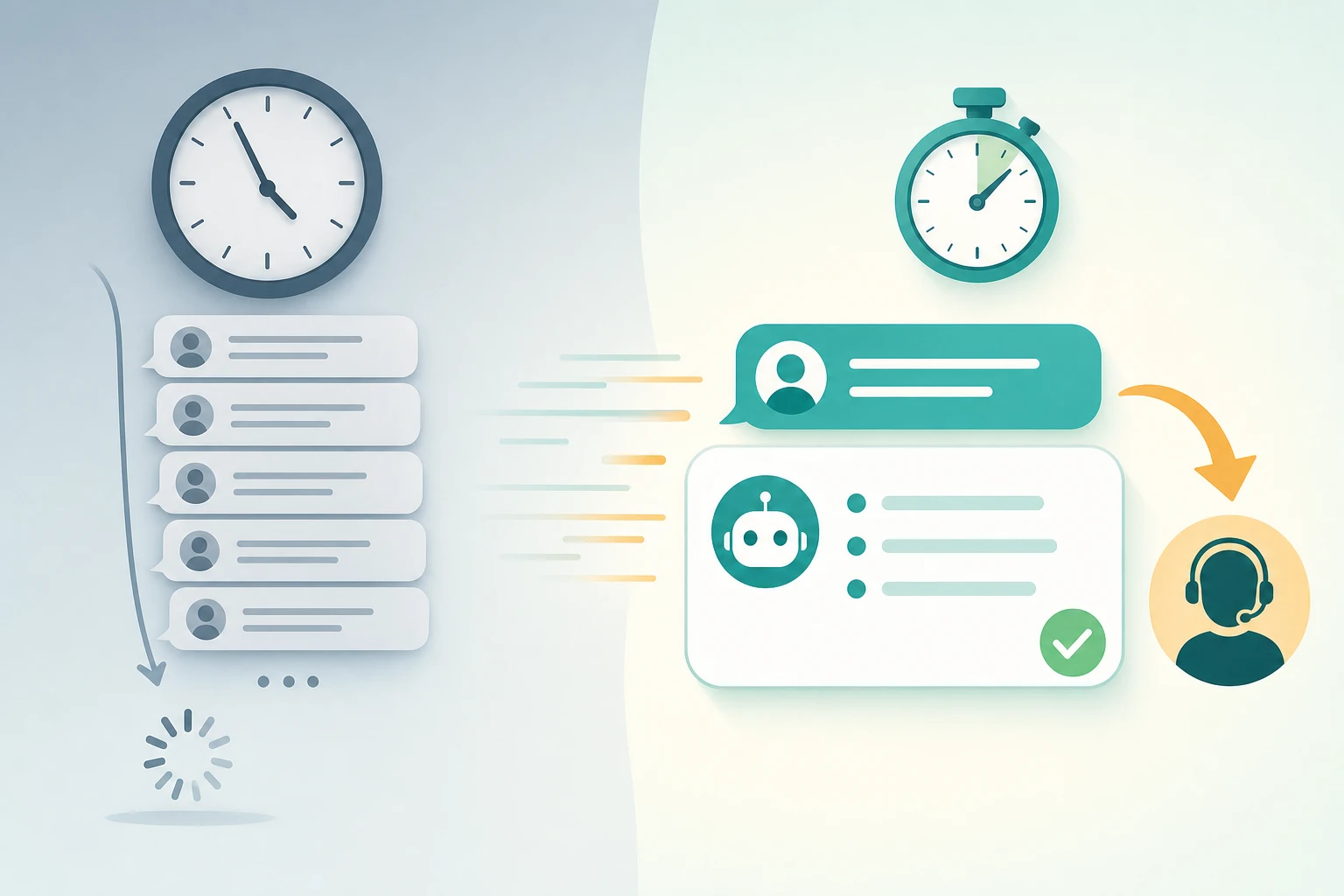
The first number a customer feels is not how fast you resolve their issue. It is how long they wait for any human-sounding reply at all, and that wait is what they remember.
First response time (FRT) is the gap between a customer reaching out and getting the first real answer. It is the cheapest support metric to improve and the easiest to fake, which is why so many dashboards show a great FRT next to customers who are still annoyed. This playbook covers what FRT actually measures, what counts as fast in 2026, why it stalls, and seven concrete ways to cut it with AI — without turning the number into a vanity stat.
First response time, defined
First response time is the elapsed time between a customer’s first message and your team’s first substantive reply. The standard calculation is an average across a period:
First response time = sum of (first reply time − inbound time) ÷ number of conversations
Two distinctions matter before you optimize anything.
FRT is not resolution time. Resolution time measures when the issue is actually solved. A team can answer in 30 seconds and still take three days to fix the problem. Report both, because a fast first reply that leads nowhere is not a win.
A reply has to be substantive to count. An automated “Thanks, we got your message and will respond within 24 hours” is an acknowledgement, not a first response. If you let auto-acknowledgements count as your FRT, you will get a beautiful number and a customer who still has not been helped. The honest version of FRT counts the first reply that moves the conversation forward.
What “fast” means in 2026
Speed expectations are set by channel, not by your team. People accept an email reply measured in hours; they will abandon a live chat in under a minute. The commonly cited 2026 benchmarks line up roughly like this:
| Channel | What customers expect | Strong target |
|---|---|---|
| Live chat | A reply within 1–2 minutes | Under 40 seconds |
| Social / messaging | A reply within the hour | Under 15 minutes |
| Same business day | Under 1 hour |
The expectation gap is real. HubSpot’s customer service research found that 90% of customers rate an “immediate” response as important or very important, and 60% define “immediate” as 10 minutes or less (HubSpot). Zendesk’s CX Trends research has repeatedly shown speed of response ranking at or near the top of what customers say defines good service (Zendesk CX Trends).
The practical reading: on chat and messaging, “fast enough” now means seconds to a couple of minutes. Email buys you more patience, but the bar there is still falling. If your live-chat FRT is measured in minutes, you are already behind the expectation, not ahead of it.
Why first response time stalls
FRT rarely stalls because agents are slow typists. It stalls structurally. The usual causes:
- The queue is single-threaded. Every conversation waits for a human to be free, so FRT tracks staffing, not effort. At 9am Monday it spikes no matter how good the team is.
- Triage happens before the answer. Tickets pile up waiting to be read, tagged, and routed before anyone replies. The first response waits on the slowest step.
- Knowledge is scattered. The answer exists — in a doc, a PDF, an old ticket — but the agent has to go find it. Search time becomes response time.
- After-hours is a dead zone. Anything that arrives outside staffed hours inherits the entire overnight gap. For a global audience, “after hours” is most of the day.
- Repetitive questions crowd the front of the line. The same handful of questions — order status, password resets, “do you integrate with X” — consume the capacity that complex issues need.
Notice that four of those five are about who answers first, not how hard the question is. That is exactly the gap an AI agent is suited to close, and exactly where it can go wrong if you bolt it on carelessly.
Seven ways to cut first response time with AI
The goal is not “reply instantly to everything.” It is to answer the answerable questions immediately, route the rest cleanly, and stop treating an empty acknowledgement as a response.
1. Put a grounded AI agent at the front of the queue
The single biggest FRT lever is removing the human from the first reply for questions that have a known answer. An AI agent trained on your help content can respond in seconds, at any hour, to the repetitive questions that make up most of the front of the queue. Vendor-reported numbers here are dramatic — Freshworks, for example, has published a case where Freddy AI took first response from roughly 12 minutes to 12 seconds (Freshworks). Treat specific vendor figures as marketing, but the direction is sound: tier-1 questions can move from minutes to seconds.
The critical word is grounded. An AI that improvises answers will cut FRT and raise your refund rate. An AI that answers only from content you control — your site, docs, and PDFs — cuts FRT safely.
2. Turn on citations so a fast answer is also a verifiable one
Speed without trust is a trap. If the AI answers in three seconds but the customer cannot tell where the answer came from, you have traded a slow-but-credible reply for a fast-but-suspect one. Showing the source behind each answer lets the customer (and your team) verify it on the spot. It is what makes an instant first response defensible rather than risky.
3. Answer after hours instead of queuing the night
Most FRT damage happens when no one is staffed. An always-on agent collapses the overnight gap for everything it can answer, and captures a clean, contextful summary for everything it cannot — so the human picking it up in the morning starts from a real answer instead of “Hi, sorry for the wait.” For a customer base in more than one timezone, this is often the largest single source of slow first responses.
4. Route, don’t just reply
Speed is not only about answering — it is about getting the right unanswerable questions to the right person fast. Use the AI to read intent and route: billing to billing, a bug report to a tech queue, an angry cancellation to a senior operator. A correct reply in two minutes beats a generic reply in twenty seconds. Routing is what keeps FRT honest when the answer needs a human.
5. Hand off with context, not a cold transfer
When the AI hits its limit, the handoff itself becomes part of the response time. A clean handoff passes the conversation, the customer’s question, and what the AI already tried to a human inbox — so the human’s “first response” is a real next step, not a re-introduction. A handoff that makes the customer repeat themselves resets the clock emotionally even if the metric looks fine.
6. Use saved replies for the human side
For the conversations that do reach an agent, well-maintained saved replies and macros shave the seconds spent typing the same opening five times an hour. This is the oldest FRT trick and still works. Keep the library small and current; a stale macro that sends wrong information is worse than a slow reply.
7. Set a public SLA you can actually hit
Publishing “we reply within X” does two things: it sets the customer’s clock so they are not refreshing for an answer, and it gives your team a target to staff against. Set it per channel, set it to something you hit 90% of the time, and let the AI agent absorb the volume that would otherwise blow the SLA at peak.
Where AI helps and where it quietly hurts
Used well, AI is the most reliable way to cut FRT because it removes the human from the first reply on the questions that do not need one. Used carelessly, it gives you a fast number and unhappy customers. The failure modes to watch:
- Auto-acknowledgements dressed up as responses. If your “instant FRT” is really an auto-reply that says nothing, you have not improved anything except the dashboard. Customers can tell the difference instantly.
- Confident wrong answers. An ungrounded model that answers fast and wrong trades a slow problem for an expensive one. Grounding and citations are not optional polish here; they are what makes speed safe.
- Dead-end bots. An AI that cannot answer and cannot hand off cleanly just adds a step before the real wait. The handoff path matters as much as the answer path.
- Gaming the metric. Splitting one conversation into several, or letting the bot’s canned line stop the clock, makes FRT look great while customer effort climbs. If FRT improves while repeat-contact rate and CSAT do not, you are measuring the wrong thing.
How to measure FRT honestly
A first response time you can defend has three properties:
- It counts only substantive first replies. Acknowledgements and “we’re looking into it” auto-messages do not stop the clock. The first reply that advances the conversation does.
- It is reported per channel. A blended FRT hides the channels where you are failing. Chat, email, and social have different bars; track them separately.
- It travels with resolution and CSAT. FRT on its own is gameable. Paired with resolution time and a satisfaction signal, it becomes trustworthy. A team whose FRT drops while CSAT holds or rises is genuinely faster. A team whose FRT drops while repeat contacts rise is just deflecting the clock.
The one-line test: if you cut your FRT in half this month, can you also show that customers got helped at least as well? If yes, it is a real improvement. If you cannot answer that, you have optimized a number, not the experience.
Where Owlish fits
Owlish is our product, so read this as a vendor being specific rather than neutral.
Owlish is built to cut first response time the honest way. The agent answers from the website, documents, and PDFs you ingest, so its instant replies stay inside content you control (knowledge base overview). You can turn on source citations, so a three-second answer is also one the customer and your team can verify (web widget docs). When the question needs a person, it hands off to a shared inbox with the context attached, so the human’s first reply is a real next step rather than a reintroduction (human handoff). And because the agent is always on, the overnight queue that usually drags FRT down gets answered instead of stacked.
That shape fits small and growing teams that want instant first responses on the repetitive questions and clean handoff on the rest. It is a weaker fit if you need a full contact center with telephony, deep ticket routing, and CRM-grade workflows — for that, a larger service platform will serve you better, and you should choose one of those. Owlish is the AI first-response layer, not the entire helpdesk.
FAQ
What is a good first response time?
It depends on the channel. For live chat, a strong target is under 40 seconds, and customers start abandoning within a minute or two. For social and messaging, aim for under 15 minutes. For email, under an hour is strong and same-business-day is the floor. A single blended target hides the channel where you are actually failing.
Is first response time the same as resolution time?
No. First response time measures how long until the first substantive reply. Resolution time measures how long until the issue is solved. You can have a fast FRT and a slow resolution, or the reverse. Report both so a fast-but-empty reply does not look like a win.
Do auto-replies count as a first response?
They should not. An auto-acknowledgement that says “we got your message” does not advance the conversation, so counting it as your FRT makes the metric meaningless. Count the first reply that actually helps — whether it comes from an AI agent or a human.
How does AI reduce first response time?
By removing the human from the first reply for questions that have a known answer. A grounded AI agent answers repetitive, well-documented questions in seconds at any hour, routes the rest, and hands off cleanly when a person is needed. The savings are real for tier-1 volume; be skeptical of any specific “X seconds” figure until you have measured it on your own content.
Can reducing first response time hurt customer satisfaction?
Yes, if you cut it by faking it. Auto-acknowledgements, confident wrong answers, and dead-end bots all lower the number while raising customer effort. FRT that comes from grounded, cited answers and clean handoff tends to hold or improve CSAT. Always watch FRT, resolution, and CSAT together.
Sources
- HubSpot — customer service research — 90% rate an immediate response as important; 60% define immediate as 10 minutes or less
- Zendesk CX Trends — consumer expectation data on response speed and availability
- Freshworks — vendor-reported Freddy AI first-response improvements
Benchmark and expectation figures in this post were gathered in June 2026 from public research and vendor materials. Treat channel benchmarks as directional ranges, not guarantees; your numbers depend on your volume, content quality, and staffing.
Trademark note
HubSpot, Zendesk, Freshworks, Freddy, and other product names mentioned here are trademarks or registered trademarks of their respective owners. Owlish is not affiliated with or endorsed by those companies unless explicitly stated.
Where to start with Owlish
If you want a faster first response that you can actually defend, start by grounding an agent in your real help content and turning on citations, then watch resolution and CSAT alongside FRT. Read the knowledge base overview, see the pricing page for plan details, then walk through building your first agent. Within a week you will know whether your faster first responses are helping customers or just moving the clock.