Agentic AI in Customer Service: What It Actually Means (and How to Deploy It Safely)
"Agentic AI" is the dominant pitch in customer service right now, but Gartner says most of it is rebranded chatbots — and customers are already losing patience. This 2026 guide defines what agentic actually means, maps the autonomy levels onto real support work, surveys the vendor landscape, and gives a safe rollout playbook.
Almost every customer-service tool now calls itself “agentic AI,” but Gartner’s own analysts have a name for most of it: agent washing — relabeling chatbots and scripted assistants as autonomous agents without the capability underneath. So before you buy on the word, it’s worth knowing what “agentic” actually means, where a support agent can safely sit on the autonomy scale today, and why deployments fail when teams skip that step.
This guide is for anyone evaluating AI for customer support in 2026. It defines the term against primary sources, maps the levels of autonomy onto the work support teams actually do, surveys what the recognizable vendors are shipping (checked June 2026), and lays out a rollout that earns the automation rather than assuming it.
What “agentic” actually means
The simplest definition comes from contrasting two things people conflate: an assistant and an agent. IBM puts the line cleanly: “AI assistants are reactive, performing tasks at your request. AI agents are proactive, working autonomously to achieve a specific goal by any means at their disposal.” (IBM)
McKinsey draws the same distinction by what the system does: agentic AI “doesn’t just generate text or code. It takes action. Whereas early large language models could answer questions or summarize information, agentic systems can now perform complex tasks independently, autonomously trigger workflows, and collaborate with other agents.” (McKinsey)
For customer service specifically, Zendesk frames it as the gap between answering and acting: “Unlike a basic chatbot that just answers questions, an autonomous service agent can classify requests, route tickets, update records,” and execute multi-step workflows with minimal human input. (Zendesk)
Put together, the useful test is this: a chatbot returns information; an agent takes an action toward a goal. A bot that retrieves your refund policy and shows it is answering. A system that reads the order, checks eligibility, issues the refund, and updates the record is acting. Most tools sold as “agentic” today live closer to the first than the second — which is exactly why the autonomy question matters more than the label.
The autonomy ladder: where a support agent actually sits
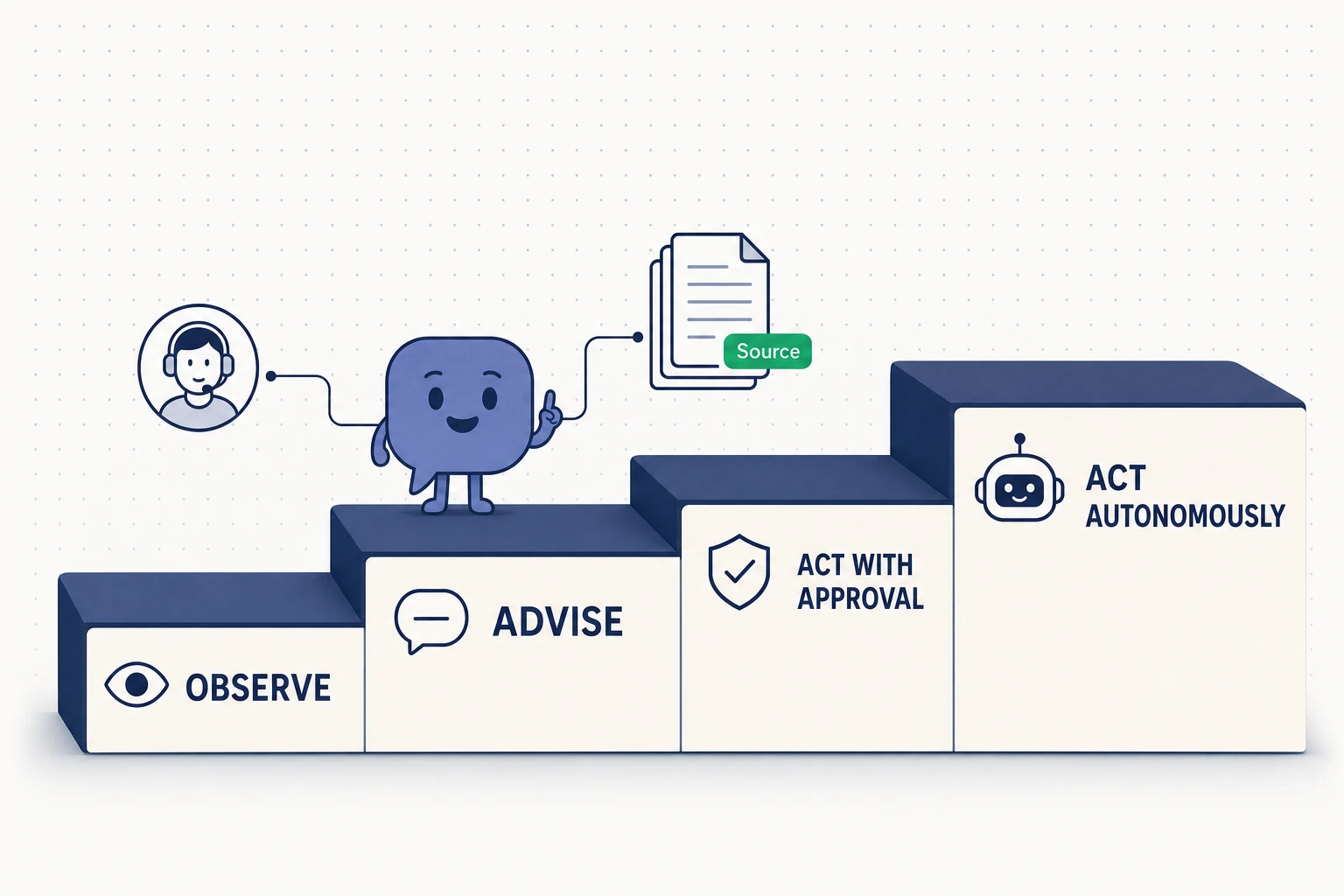
“Agentic” is not a binary. The most useful way to think about it is a ladder of autonomy, and the clearest public version comes from Gartner’s May 2026 framework, which defines four levels by how much a human stays in the loop:
| Level | What the agent does | The human’s role |
|---|---|---|
| 1. Observe | Read-only. Summarizes, retrieves, explains. | Does everything; the agent just informs. |
| 2. Advise | Drafts answers and recommendations. | Reviews and sends every reply. |
| 3. Act with approval | Can write data, send messages, change settings — but only after sign-off on each action. | Approves every individual action. |
| 4. Act autonomously | Executes within set guardrails. | Reviews exceptions, audit logs, and aggregate outcomes — not each decision. |
Source: Gartner, May 26, 2026. Salesforce publishes a parallel five-rung “agentic maturity model” running from fixed-rule chatbots up to multi-agent orchestration, with the same shape: autonomy and scope climb together. (Salesforce)
Here is the part vendors gloss over. Most customer-support value lives on the lower rungs, and most risk lives on the higher ones. An agent that answers a billing question from your help center, cites the source, and hands off when it’s unsure is a Level 2 system doing real work safely. An agent that issues refunds, cancels accounts, or changes a shipping address unattended is Level 3 or 4 — genuinely useful, but every one of those actions is a place a wrong answer turns into a wrong outcome your business has to unwind.
The mistake is treating Level 4 as the only “real” agentic AI and rushing there. The right question isn’t “how autonomous can it be?” It’s “which specific actions has this earned the right to take unattended, and what catches it when it’s wrong?” For most teams, the honest answer in 2026 is: answer broadly, act narrowly, and escalate cleanly. That maps to where an AI agent differs from a chatbot without pretending the whole job can be handed over at once.
”Agent washing”: how to tell a real agent from a relabeled chatbot
Gartner coined the term and put a number on the fallout: “Over 40% of agentic AI projects will be canceled by the end of 2027, due to escalating costs, unclear business value or inadequate risk controls,” driven in part by vendors “rebranding of existing products, such as AI assistants, robotic process automation and chatbots, without substantial agentic capabilities.” (Gartner, June 25, 2025)
You don’t need a framework to see through agent washing. You need four questions, asked against your own content during a trial:
- Does it act, or only answer? Ask the vendor to name the specific actions the agent can take in your systems, not in a demo. If the only answer is “it responds to questions,” it’s an assistant. That’s fine — but price and deploy it as one.
- Where do its answers come from? A real agent grounds every answer in a source you control and can show you the citation. If it can’t tell you which document an answer came from, you can’t audit it, and you can’t trust it to act on it.
- What does it do when it doesn’t know? A trustworthy agent refuses and escalates. One that always produces a confident answer is optimized to look agentic, not to be correct — and that’s where AI support agents fail.
- How is autonomy bounded? Ask which actions are unattended versus approval-gated, and what the guardrails are. “It just figures it out” is not a guardrail.
If a tool can’t answer those four cleanly, the “agentic” label is doing more work than the software.
The vendor landscape (June 2026)
The recognizable names all ship something they call an AI agent, and the positioning is converging on the word “resolution.” This is orientation, not a ranking — what each calls its offering, and one claim you can check, as of June 2026:
- Zendesk sells “AI agents” inside its Resolution Platform, positioned to “resolve even the most complex issues on any channel autonomously.” (Zendesk)
- Intercom (Fin) — the company rebranded around its Fin AI Agent — prices on outcomes: $0.99 per outcome, billed for one outcome per conversation. (Note the unit is “outcome,” which includes but is broader than a resolution.) (Fin pricing)
- Salesforce Agentforce runs on its Atlas reasoning engine and self-reports resolving 85% of visitor issues on the Salesforce Help site — a vendor’s own result on its own property, not an independent benchmark. (Salesforce)
- Ada positions its agent as one that can “resolve, act, and continuously improve.” (Ada)
- Sierra, co-founded by Bret Taylor, builds branded customer-experience agents on its Agent OS. (Sierra)
- Decagon markets “AI concierge” agents aimed at high-volume consumer support. (Decagon)
Two things to take from the landscape. First, “resolution” is becoming the unit of value and the unit of billing — which is why it pays to understand what per-resolution and per-outcome pricing actually charge for before you sign. Second, the heavyweight platforms (Zendesk, Salesforce) bundle agents into full service suites; the AI-native vendors (Ada, Sierra, Decagon, Fin) lead with the agent itself. Which shape fits depends on whether you already run a contact-center platform or are adding an answering layer to a website.
The reality check: customers are already losing patience
The forecasts are loud. Gartner projects that “by 2029, agentic AI will autonomously resolve 80% of common customer service issues without human intervention,” and Salesforce’s 2025 State of Service found 79% of service leaders consider investing in AI agents essential. (Gartner, Salesforce)
The ground truth is harsher. A June 2026 report covered by CX Dive found that 60% of consumers will repeat themselves only once before abandoning an automated system, and only 14% fully trust AI to handle complex requests. (CX Dive) And the constraint isn’t model quality — it’s plumbing: Microsoft’s 2026 Work Trend Index reports that nearly 80% of organizations say they can’t share data across teams in the ways agentic AI needs to work. (Microsoft)
That gap between the forecast and the experience is the whole ballgame. An agent set loose without grounding, guardrails, or a clean exit doesn’t read as “advanced.” It reads as the same automated wall customers have learned to hate, now able to take actions when it’s wrong. The teams that win with agentic AI aren’t the ones that automate the most. They’re the ones that automate the parts the agent has actually earned, and route the rest to a person fast.
How to deploy agentic AI safely
A rollout that survives contact with real customers looks less like flipping a switch and more like granting permissions one at a time.
1. Start grounded, not autonomous
Before an agent can safely act, it has to reliably answer. Point it at your real knowledge — help center, PDFs, product docs, policy pages — and require every answer to trace to one of those sources. Grounding is what turns “what does a refund policy usually look like?” into “what does this company’s refund policy say?” Skip it and every higher rung inherits a guessing engine. (This is also the cure for hallucinations.)
2. Draw the action boundary explicitly
Write down which actions the agent may take unattended, which require approval, and which it must never take. Tie each to the autonomy ladder above. A safe starting boundary for most teams: answer anything it can ground and cite; never quote a price, make a commitment, or touch an account unattended; hand those to a human. You can widen the boundary later as you see the agent earn it — but make it a deliberate decision, not a default.
3. Keep a human on the exceptions
Autonomy at the top rungs doesn’t mean no humans — it means humans review exceptions and outcomes instead of every message. Design the handoff before launch: it should trigger before the agent is tempted to improvise, and carry the full conversation context so the customer never repeats themselves. A clean escalation is a feature, not a failure.
4. Disclose that it’s AI
If you serve customers in the EU, this stops being optional on 2 August 2026, when the EU AI Act’s Article 50 transparency obligation applies: systems “intended to interact directly with natural persons” must make clear the person is dealing with an AI. (EU AI Act, Article 50) Disclosure is good practice everywhere — it removes the “I thought it was a person” complaint and sets honest expectations.
5. Measure resolution, not containment
The number that flatters a dashboard is containment — how many conversations stayed in the bot. The number that matters is whether the issue was actually solved. Pair any automation rate with repeat-contact rate and CSAT, or you’ll celebrate customers who gave up. The difference between resolution, deflection, and containment is where a lot of “agentic” wins quietly evaporate.
Where Owlish fits
Owlish is a no-code platform for the foundation every safe agentic deployment starts from: grounded, cited answering with a clean human handoff. You point it at your knowledge — websites, PDFs, documents, help center — and it builds an AI agent that answers customer questions in a web widget (and in Slack, Teams, and Discord), grounded in those sources, with a citation on every answer so each reply is verifiable. When a question falls outside what it should handle, it hands off to a human operator with the full conversation attached.
On the autonomy ladder, that’s deliberately Level 2 territory done well — answer broadly, cite the source, escalate cleanly — rather than a Level 4 system turned loose on your billing system. Pricing is flat and session-based, not per-resolution or per-outcome, so an agent that gets better at resolving doesn’t cost you more each time it succeeds: there’s a free tier, then Starter at $49/mo ($39/mo billed annually), Growth at $149/mo ($119/mo annually), and Scale at $449/mo ($359/mo annually) — roughly 20% off on annual billing. Human handoff is available from the Growth plan.
The honest boundary: Owlish is a strong fit if you want accurate, cited, 24/7 answers in front of customers and a clean path to a person for everything else, without an engineering project or a per-resolution meter. It is not a full enterprise contact-center suite with telephony and workforce routing, and it does not yet run a library of autonomous back-office actions like issuing refunds or modifying orders unattended. If you need an agent that acts deep inside your order or CRM systems today, a platform like Salesforce or Zendesk is the better home — and you can still run a grounded answering layer in front of it.
Frequently asked questions
What is agentic AI in customer service? It’s AI that takes action toward a goal rather than only answering questions — classifying a request, routing a ticket, updating a record, or resolving an issue end-to-end with limited human supervision. The practical distinction from a chatbot is acting versus answering: a chatbot returns your refund policy; an agent can check eligibility and process the refund.
Is agentic AI the same as a chatbot? No. A chatbot is reactive and answers within a narrow script or knowledge base. An agentic system is goal-directed and can carry out multi-step tasks. Many tools marketed as “agents” in 2026 are still chatbots — Gartner calls the relabeling “agent washing.” Test it by asking what specific actions it can take in your systems.
How autonomous should a customer-support agent be? Match autonomy to risk. Answering questions from grounded sources is safe to automate broadly. Actions that touch money, accounts, or commitments should stay approval-gated or off-limits until the agent has demonstrably earned them. Most teams in 2026 are best served by answering broadly, acting narrowly, and escalating the rest.
Will agentic AI replace human support agents? Not wholesale. Forecasts like Gartner’s 80%-by-2029 figure refer to common issues, and even there humans move to reviewing exceptions, tuning the agent, and handling judgment calls. The roles change more than they disappear — running the agent becomes part of the job.
Do I have to tell customers they’re talking to AI? In the EU, yes, from 2 August 2026 under the EU AI Act’s Article 50 transparency rule. Outside the EU it’s not universally mandated, but disclosing it is good practice and avoids the “I didn’t know it was a bot” complaint.
Sources
- IBM — AI agents vs. AI assistants
- McKinsey — Agentic AI explained
- Zendesk — Autonomous service agents
- Gartner — AI agent autonomy levels / governance (May 26, 2026)
- Gartner — 40% of agentic AI projects canceled by 2027 / “agent washing” (June 25, 2025)
- Gartner — 80% of common issues resolved by 2029 (March 5, 2025)
- Salesforce — Agentic maturity model and State of Service 2025
- CX Dive — Customers are losing patience with automated support (June 22, 2026)
- Microsoft — 2026 Work Trend Index
- EU AI Act — Article 50
Vendor positioning checked against official pages in June 2026. Company and product names are trademarks of their respective owners; Owlish is not affiliated with or endorsed by them.
Want the grounded answering layer the whole ladder is built on? Start a free Owlish agent on your own content, or read how to choose AI customer support software for a buyer’s checklist you can run during a trial.