Why AI Support Agents Get Rolled Back After Launch
Most AI support agents fail weeks after launch, not at launch. Here are the five failure modes that cause rollbacks and the controls that keep an agent live.
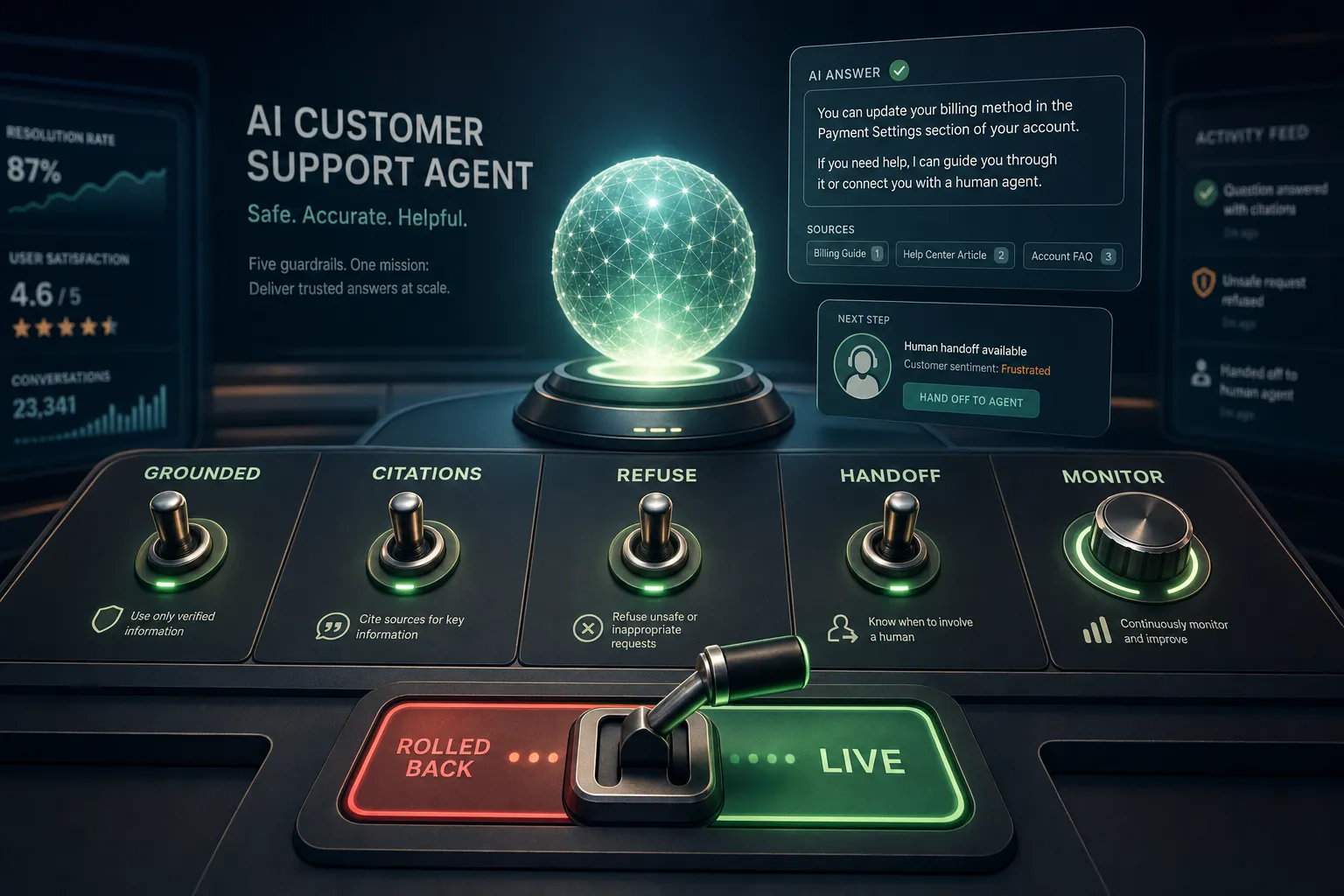
Most AI support agents do not fail at launch. They fail a few weeks later, quietly, when a wrong answer reaches a real customer and someone decides the risk is not worth it.
New research puts a number on that pattern. In The AI Production Paradox, published May 13, 2026, Sinch reported that 74% of enterprises have rolled back or shut down a live AI customer communications agent after deployment. The survey covered 2,527 senior decision-makers across 10 countries between January and February 2026. (Sinch, corroborated by The Register)
This is enterprise data, not small-business data, so do not read it as “74% of all chatbots fail.” But the failure modes behind a rollback are not enterprise-specific. They are the same five problems that take down a website chatbot at a 12-person company. This post is about those five failure modes and the controls that prevent them, so your agent survives contact with real customers.
The paradox: more governance, more rollbacks
The counterintuitive finding is the one worth sitting with. The rollback rate was higher among organizations with mature governance — 81% of teams with fully mature guardrails had pulled an agent, versus 74% overall. Meanwhile 62% already had agents in production and 98% said they were still increasing AI investment in 2026. (Sinch)
That is not a story about governance failing. It is a story about governance working: teams that monitor their agents catch the bad answers and act on them. Teams without monitoring do not roll back because they cannot see the problem yet. The rollback is the symptom of a missing operating model, not a missing policy document.
So the right question is not “should we deploy an AI support agent?” Adoption is already here. The question is “what keeps a deployed agent trustworthy enough to leave on?”
The trust gap is real on the customer side too. Australia’s National AI Centre, in its December 2025 to February 2026 adoption insights, found that about 65% of non-adopting small and medium businesses cited distrust in AI decision-making or a preference for human control, and 19% did not know how to use AI in their business. (AI.gov.au) Customers carry the same instinct. An agent that cannot show its work, or cannot get out of the way, confirms the fear.
Failure mode 1: ungrounded answers
The most common reason an agent gets pulled is that it made something up. It invented a refund window, quoted a price that changed last quarter, or confidently described a feature that does not exist.
This is not a model defect you can prompt away. A general language model will always try to produce a fluent answer, even when it has nothing reliable to draw on. The fix is architectural: the agent should only answer from your sources — your help center, your docs, your policy PDFs — and retrieve the relevant passage before it writes a word.
That pattern (retrieval-augmented generation) reduces fabrication, but it does not eliminate it. If retrieval pulls the wrong passage, or your source material is contradictory, the agent can still produce a “grounded-but-wrong” answer. Grounding is the floor, not the ceiling. It has to be paired with the next four controls.
The control: restrict every answer to retrieved source content, and treat your knowledge base as the product surface it actually is. See our guide to building an AI knowledge base for support for how to structure sources so retrieval lands on the right passage.
Failure mode 2: no permission to refuse
The second failure mode is subtler. The agent is grounded, but it will not stop. Asked something outside its sources, it stretches — combining unrelated passages, guessing at intent, or padding an answer to sound complete.
An agent that cannot say “I don’t have that information” is more dangerous than one that answers nothing. A blank is recoverable. A confident wrong answer about a cancellation policy becomes a chargeback dispute.
The control: make refusal a first-class behavior, not an edge case. The agent should recognize when its sources do not cover a question and respond with a clear “I can’t confirm that — let me get you to someone who can,” then escalate. Refusal plus handoff is what turns a gap into a graceful moment instead of a fabricated one.
Failure mode 3: the dead-end handoff
Even a careful agent will hit questions it should not answer: a billing exception, an angry customer, a high-stakes account change. What happens next decides whether customers trust the whole system.
The classic failure is the dead-end loop — the bot says “I’ll connect you to an agent,” and nothing happens, or the customer lands in a queue and has to re-explain everything from scratch. That single experience teaches customers to distrust every future answer, including the correct ones.
Handoff is now treated as a design problem in its own right, not a fallback. The seam between AI and human is where most of the perceived quality lives.
The control: design the handoff explicitly. Decide the triggers (low confidence, negative sentiment, sensitive topics, explicit requests for a human), and make sure the human receives the full transcript, the sources the agent tried, and the customer’s context — so the person picks up mid-conversation instead of starting over. Our human handoff guide breaks down the triggers and the context packet in detail.
Failure mode 4: stale knowledge
An agent that was accurate at launch slowly drifts. Pricing changes, a policy updates, a product ships, and the source the agent retrieves from still says the old thing. Now it is grounded, confident, citing a source — and wrong.
Stale knowledge is the failure mode teams notice last, because nothing breaks visibly. The agent keeps answering smoothly. It is just answering with last quarter’s truth.
The control: assign every high-risk source an owner and a refresh cadence. Pricing, refunds, shipping, compliance, and account policies should be reviewed at least monthly and whenever a launch changes the customer experience. The simplest rule: if a human operator would need the update, the AI’s source needs it too. Citations help here, because a visible source link makes a stale answer auditable instead of invisible.
Failure mode 5: no visibility after launch
The throughline of the Sinch finding is that the teams who rolled back were the ones who could see. You cannot manage what you do not measure, and most agents are deployed with a launch dashboard that nobody looks at again.
Worse, the metric teams usually watch — deflection — actively hides the problem. A “deflected” ticket is just one the customer abandoned. It might mean the agent resolved the issue, or it might mean the customer gave up and churned. Deflection counts both as a win.
The control: measure genuine resolution, not deflection. Track whether the customer came back within a few days with the same problem (repeat-contact rate), whether they escalated, and whether cited answers correlate with higher satisfaction. Read the support metrics that actually matter for the full instrumentation. The point is to catch a bad answer pattern in week two — and fix the source — instead of discovering it in a churn report in month three.
A pre-launch checklist
Before you turn an AI support agent on for real customers, you should be able to answer yes to all of these:
- Grounding: does every answer come from a retrieved source, not the model’s general knowledge?
- Citations: can a customer (and your QA team) see which source produced each answer?
- Refusal: does the agent reliably say “I don’t know” instead of guessing when its sources don’t cover a question?
- Handoff: is there a tested path to a human that carries the transcript and context, with clear escalation triggers?
- Freshness: does every high-risk source have an owner and a review cadence?
- Monitoring: are you tracking repeat-contact and escalation rates, not just deflection, from day one?
If you can only check three of six, launch with a narrower scope — fewer answerable topics, not weaker controls. An agent that confidently handles ten questions and hands off the rest beats one that attempts everything and gets pulled in a month.
Where Owlish fits
Owlish is our product, so here is the honest version. The five controls above are the architecture Owlish is built around, which is the entire reason this post is worth us writing.
- Grounded answers. Owlish answers only from the website pages, documents, and PDFs you ingest. If the knowledge does not cover a question, it says so rather than inventing a policy.
- Citations on every answer. Customers and operators can see the source behind each reply, which makes answers auditable and makes a stale source visible.
- Refusal and human handoff. When the agent is unsure or the question is delicate, it routes to a teammate with the full transcript, the citations it tried, and the visitor context — no re-explaining.
- Pre-launch testing. The playground lets you compare answers, citations, and latency on your live knowledge base before you ship, so you find the gaps before customers do.
- An operator inbox. Every conversation across the web widget, Slack, and Microsoft Teams lands in one queue your team can monitor, tag, and take over.
Owlish is built for small and growing support teams that want grounded answers across a web widget and chat channels without code. It is not an enterprise omnichannel communications platform. If your problem is the one Sinch describes at the top of the market — custom cross-channel infrastructure spanning voice, SMS, and large-scale telephony — a dedicated enterprise CCaaS platform is the right tool, and Owlish is not pretending to be that.
But if your AI support agent risk looks like the five failure modes above — fabrication, no refusal, dead-end handoff, stale sources, no visibility — those are exactly the problems grounded retrieval, citations, and clean handoff are designed to prevent.
FAQ
Why do companies roll back AI customer support agents?
The most common reasons are ungrounded answers (the agent fabricates a policy or fact), no clean path to a human, stale source content that makes the agent confidently wrong, and no post-launch monitoring to catch bad answers early. Sinch’s May 2026 research found 74% of surveyed enterprises had rolled back or shut down a live AI customer communications agent after deployment. (Sinch)
Does retrieval-augmented generation (RAG) stop AI hallucinations?
It reduces them, but it does not eliminate them. Grounding the agent in your sources removes the biggest cause of fabrication, but the agent can still produce a “grounded-but-wrong” answer if retrieval pulls the wrong passage or your sources contradict each other. Grounding has to be paired with the ability to refuse, a human handoff, fresh sources, and monitoring.
What is the difference between deflection and resolution?
Deflection counts any conversation the customer did not escalate to a human, including ones where they simply gave up. Resolution measures whether the customer’s problem was actually solved — usually checked by whether they came back with the same question within a few days. Optimizing for deflection can hide churn; optimizing for resolution does not.
How do I keep an AI support agent trustworthy after launch?
Treat it as an operating model, not a one-time deployment. Ground every answer in your sources, show citations, let the agent refuse and hand off when unsure, assign owners and a refresh cadence to high-risk sources, and monitor repeat-contact and escalation rates from day one so you catch problems in week two instead of month three.
Is a 74% rollback rate true for small businesses?
The Sinch figure comes from a survey of enterprises with 1,000 or more employees, so it should not be read as a universal failure rate for small-business chatbots. The value of the finding is the failure modes it exposes, which apply at any size. A small team can avoid most of them by launching with a narrow, well-sourced scope and the controls in this post.
Launch narrow, then widen
The teams that keep their AI support agents live are not the ones with the biggest knowledge base or the most expensive model. They are the ones who grounded every answer, showed their sources, gave the agent permission to refuse, designed the handoff, kept the content fresh, and watched the right metrics.
If you want to build on that foundation in Owlish, start with one help-center URL, add a few direct answers for your highest-volume questions, turn on citations, and test the top questions in the playground before you widen the rollout. Launch narrow, prove it, then expand.