Per-Resolution AI Support Pricing: What Zendesk, Intercom Fin, and Ada Actually Charge
Per-resolution AI support pricing sounds fair — you only pay when the bot solves something. But the definition of 'resolution' is slippery and the bill grows as your AI improves. Here's what the major vendors charge, the traps, and how to predict your bill (June 2026).
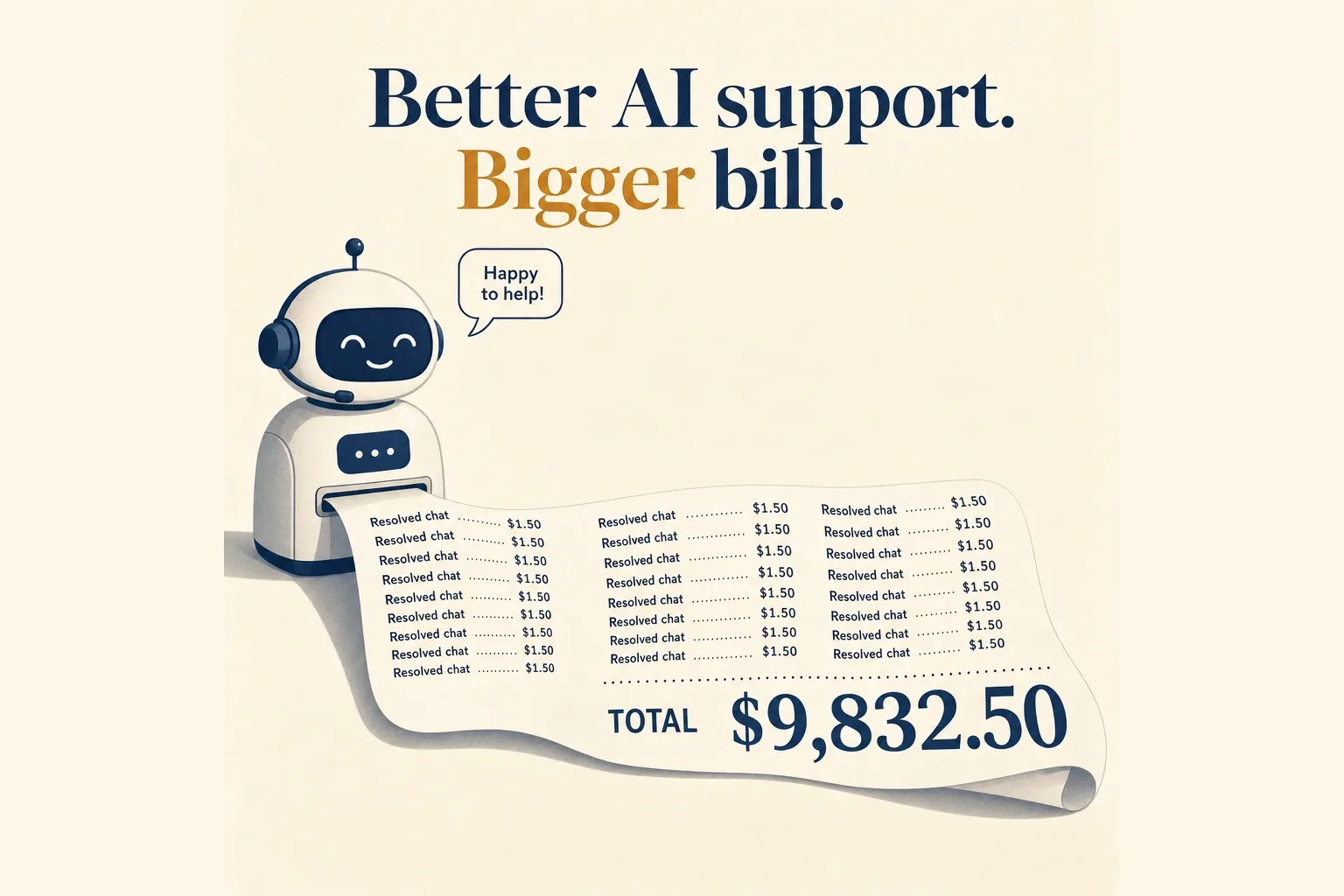
Per-resolution pricing for AI support agents sounds like the fairest deal in software: you only pay when the bot actually solves something. The catch is that “resolution” is defined by the vendor, not by you — and the better your AI gets, the bigger your bill grows.
This guide explains what per-resolution (also called outcome-based) pricing really is, what the major vendors charge as of June 2026, the two traps that surprise buyers after they sign, and a practical way to estimate and cap your bill before you commit. Pricing here is anchored to official pages and announcements wherever possible; where a vendor doesn’t publish numbers, this guide says so instead of guessing.
What “per-resolution pricing” actually means
In a per-resolution model, you pay a fixed amount each time the AI agent closes a conversation on its own — typically something like $0.75 to $2.00 per resolved conversation — instead of paying per human seat or a flat monthly fee. If the agent can’t help and the conversation goes to a person, most vendors don’t charge for that interaction.
On paper this aligns price with value. In practice, everything depends on one word: resolution. There is no industry standard for it, and each vendor draws the line in a place that’s convenient for its meter:
- Intercom Fin counts a resolution when “no further help is requested after Fin’s last answer.” (Intercom/Fin pricing, June 2026)
- Zendesk charges for an “automated resolution” only when the AI agent fully resolves a query without a human; escalated conversations aren’t billed. (Computer Weekly, Sept 2024)
- Other vendors use a timer — for example, five minutes of customer silence counts as “resolved,” a definition Ada itself flags as the “containment trap,” where a customer giving up gets recorded as a win. (Ada, 2026)
The difference matters because a silence-based or “no further reply” definition bills you for conversations the customer abandoned in frustration. We unpack the metric side of this in resolution rate vs deflection rate vs containment rate; the pricing takeaway is simpler: ask the vendor to define “resolution” in writing before you sign, because that single sentence sets your bill.
What the major vendors charge (June 2026)
Here’s where the recognizable AI-support vendors land. All figures were checked in June 2026; per-resolution rates change and several vendors gate exact numbers behind sales, so treat this as a starting point and confirm on a quote.
| Vendor | Pricing model | Per-resolution rate | Notes |
|---|---|---|---|
| Intercom (Fin) | Per resolution | $0.99 / resolution | 50 resolutions/mo minimum when used on a non-Intercom helpdesk; seats billed separately |
| Zendesk | Per resolution + seats | ~$1.50 committed / $2.00 pay-as-you-go | Allowances included per plan; exact figures now routed to sales |
| Ada | Per conversation or per resolution (custom) | Not published | Enterprise contracts; third-party estimates start around $30k/yr plus per-interaction fees |
| Help Scout | Per resolution add-on | $0.75 / resolution | ”AI Answers” billed on top of per-user inbox seats |
| Gorgias | Per resolution add-on | ~$0.90–$1.00 / resolution | Resolutions can also count against helpdesk ticket quotas |
A few honest caveats:
- Zendesk announced its outcome-based model in September 2024 at roughly $1.50 per resolution (committed volume) and $2.00 pay-as-you-go, with each plan tier including a baseline allowance per agent. As of June 2026, Zendesk’s public pricing page no longer prints the per-resolution figures — it routes you to “Contact Sales.” (Computer Weekly, Sept 2024; Zendesk pricing, June 2026)
- Ada does not publish pricing at all. It has used both resolution-based and conversation-based models depending on the deal, and has written publicly about moving enterprise customers toward conversation-based pricing for predictability. The dollar figures floating around ($30k+/yr platform fees plus per-interaction charges) come from third-party marketplaces, not Ada, so verify any number against your own quote. (Ada, 2026)
- Fin’s $0.99 is the clearest published per-resolution price in the market, which is part of why it gets quoted so often. Remember it sits on top of Intercom seat costs if you use the full suite.
The paradox: your bill goes up as your AI gets better
This is the part buyers feel three months in, not on the pricing page. In a per-resolution model, every improvement you make to your AI — better knowledge base, cleaner help docs, a smarter model — increases the share of conversations the bot resolves, which increases the number of billable resolutions, which increases your bill.
You’re not imagining it, and it isn’t a niche complaint. Ada, a per-resolution vendor itself, describes the model as one that can punish success: costs “rise as AI improves,” which “stalls adoption” because teams hesitate to push automation higher when doing so raises the per-month invoice. (Ada, 2026)
Compare the incentives:
- Per-resolution: the vendor earns more when your resolution rate climbs. Your interests and theirs diverge exactly when the product is working.
- Per-seat or flat: the vendor’s revenue is fixed regardless of how well the AI performs, so a better resolution rate is pure ROI for you — more deflection at the same cost.
Neither model is evil, but you should know which way the incentive points. If you’re going to spend the next year improving your agent (you should), a model that taxes each improvement deserves a hard look at the math.
The “resolution” definition trap, in dollars
Walk through a realistic month. Say 10,000 customers open a chat. Your AI fully answers 4,000, another 2,000 get a partial answer and then go quiet, 1,000 abandon immediately, and 3,000 escalate to a human.
- Under a strict “fully solved, confirmed, no human touch” definition, you pay for ~4,000 resolutions.
- Under a “no further reply within X minutes” definition, the 2,000 quiet-quitters and possibly the 1,000 abandons get counted too — so you pay for 6,000–7,000.
At $1.50 per resolution that’s the difference between $6,000 and ~$10,000 for the same month of work, decided entirely by a definition you didn’t write. This is why the metric and the price are the same conversation. Before signing any per-resolution contract, get written answers to:
- What exactly counts as a resolution — explicit confirmation, no human handoff, or just silence?
- Are abandoned and timed-out conversations billable?
- If a customer re-opens the same issue within 24 hours, is that one resolution or two?
- Do escalations to a human cost anything?
- Is there a monthly minimum, and does it roll over?
When per-resolution pricing is the right call
It isn’t all downside. Outcome-based pricing genuinely fits some teams:
- High-volume, high-deflection support where most questions are repetitive and genuinely solvable by AI. If your resolution rate is high and stable, paying per resolution can beat stacking enough human seats to cover the same load.
- Seasonal or spiky volume where a flat plan sized for your peak would waste money in the quiet months. Per-resolution scales down automatically when traffic drops.
- Teams that want a clean ROI story for finance — “we paid $X and avoided Y human-handled tickets” is an easy sentence to defend, as long as the resolution definition is honest.
If that’s you, negotiate a committed-volume rate (usually cheaper than pay-as-you-go), insist on the strict resolution definition, and put a billing cap or alert in the contract.
How to predict and cap your bill
Per-resolution pricing is only scary when it’s unbounded. Make it boring:
- Estimate from your real numbers. Take last quarter’s monthly chat volume, multiply by a realistic resolution rate (start at 40–55% for a well-grounded agent on a normal question mix, not the 80% on the slide), then by the per-resolution rate. That’s your floor; add 20% for growth.
- Model the bad month, not the average. Run the same math at peak volume and a higher resolution rate. If that number scares finance, a flat or per-seat plan may serve you better.
- Get a hard cap. Ask for a contractual monthly ceiling or an automated alert at 80% of budget. Some vendors bill above committed volume automatically with no cap and no warning — confirm in writing how overage works before you sign.
- Re-price annually. Your resolution rate will rise. Re-run the math each renewal so a model that was cheap at launch doesn’t quietly become your biggest line item.
The alternatives: per-seat, per-conversation, and flat
Per-resolution is one of four models you’re actually choosing between. The other three trade the “pay only for wins” promise for predictability:
- Per-seat (classic helpdesk): you pay per human agent, AI bundled or added on. Predictable, but you’re paying for human capacity even as AI removes the need for it.
- Per-conversation: you pay for every conversation the AI handles regardless of outcome. Simpler to audit than per-resolution (no arguing over what counts as solved), but you pay for misses too. Ada has publicly favored this for enterprise predictability. (Ada, 2026)
- Flat / tiered with a usage allowance: a fixed monthly price includes a set number of conversations, with predictable add-on packs if you exceed it. Your bill doesn’t move when your AI improves — better resolution rate is pure savings.
There’s no universal winner. Budget-conscious small teams usually want predictability (flat or per-conversation). High-volume enterprise teams with stable, audited resolution rates can come out ahead on per-resolution. The mistake is picking a model on its headline promise instead of on your own volume and resolution math.
Where Owlish fits
Owlish uses the flat, tiered model on purpose. You get a fixed monthly price with an included number of chat sessions, and predictable add-on packs if you go over — your bill doesn’t climb every time the agent resolves more:
- Free — $0, 25 sessions/mo, one web agent.
- Starter — $49/mo monthly · $39/mo billed annually (save ~20%), 100 sessions/mo.
- Growth — $149/mo monthly · $119/mo billed annually, 400 sessions/mo, human handoff and a shared inbox.
- Scale — $449/mo monthly · $359/mo billed annually, 1,000 sessions/mo, multi-channel.
- Need more volume on any paid plan? Extra session packs are $29 per +100 sessions — opt-in, so nothing auto-bills you by surprise.
Be clear about what this means: Owlish meters by session (a full conversation), not by resolution. So Owlish is closer to the per-conversation model than per-resolution — with the upside that improving your agent’s accuracy doesn’t raise your invoice, and the trade-off that you’re paying for the conversation whether or not it ends in a clean resolution. What you get for that session is the part that matters most for trust: answers grounded in your ingested website, docs, and PDFs, with source citations on by default, and an honest human handoff with full transcript when the agent can’t help. Setup is no-code — point it at your content and deploy to a web widget or Slack.
Owlish is not the right tool if you need a full enterprise contact center with telephony, CRM-based routing, and outcome-based billing your finance team has standardized on — that’s Zendesk, Intercom, or Ada territory. If you’re a small or growing team that wants grounded answers and a predictable bill, the flat model is built for you. For the broader buying framework, see how to compare AI customer support pricing.
FAQ
Is per-resolution pricing cheaper than per-seat?
It depends entirely on your volume and resolution rate. For high-volume teams with a strong, stable resolution rate, per-resolution can undercut the cost of enough human seats to cover the same load. For lower-volume teams, a flat plan is usually cheaper and far more predictable. Run both numbers on your real traffic before deciding.
What counts as a “resolution”?
There’s no industry standard — each vendor defines it. Intercom Fin counts it when no further help is requested after the bot’s last answer; Zendesk requires a full resolution with no human handoff; some vendors use a silence timer. Always get the definition in writing, because it directly sets your bill.
Why does my bill go up when my AI gets better?
Because in a per-resolution model you pay for each conversation the AI resolves, and a better agent resolves more of them. Ada, a per-resolution vendor itself, has described this as the model “punishing success.” Flat and per-seat models don’t have this problem.
Do I get charged when the AI fails and a human takes over?
With most per-resolution vendors, no — escalated conversations aren’t billed as resolutions. But confirm it, and confirm whether abandoned or timed-out conversations count, since those are the gray area where definitions differ.
Does Owlish charge per resolution?
No. Owlish uses flat monthly tiers with an included number of chat sessions and optional add-on packs, so your bill doesn’t rise as your agent resolves more. It’s metered by conversation (session), not by outcome.
Pricing and product details reflect public information gathered in June 2026 and may change; verify current figures on each vendor’s pricing page or your quote. Zendesk, Intercom, Fin, Ada, Help Scout, Gorgias, Slack, and other product names mentioned here are trademarks or registered trademarks of their respective owners. Owlish is not affiliated with or endorsed by those companies unless explicitly stated. This article is provided for buyer guidance, not as an endorsement.