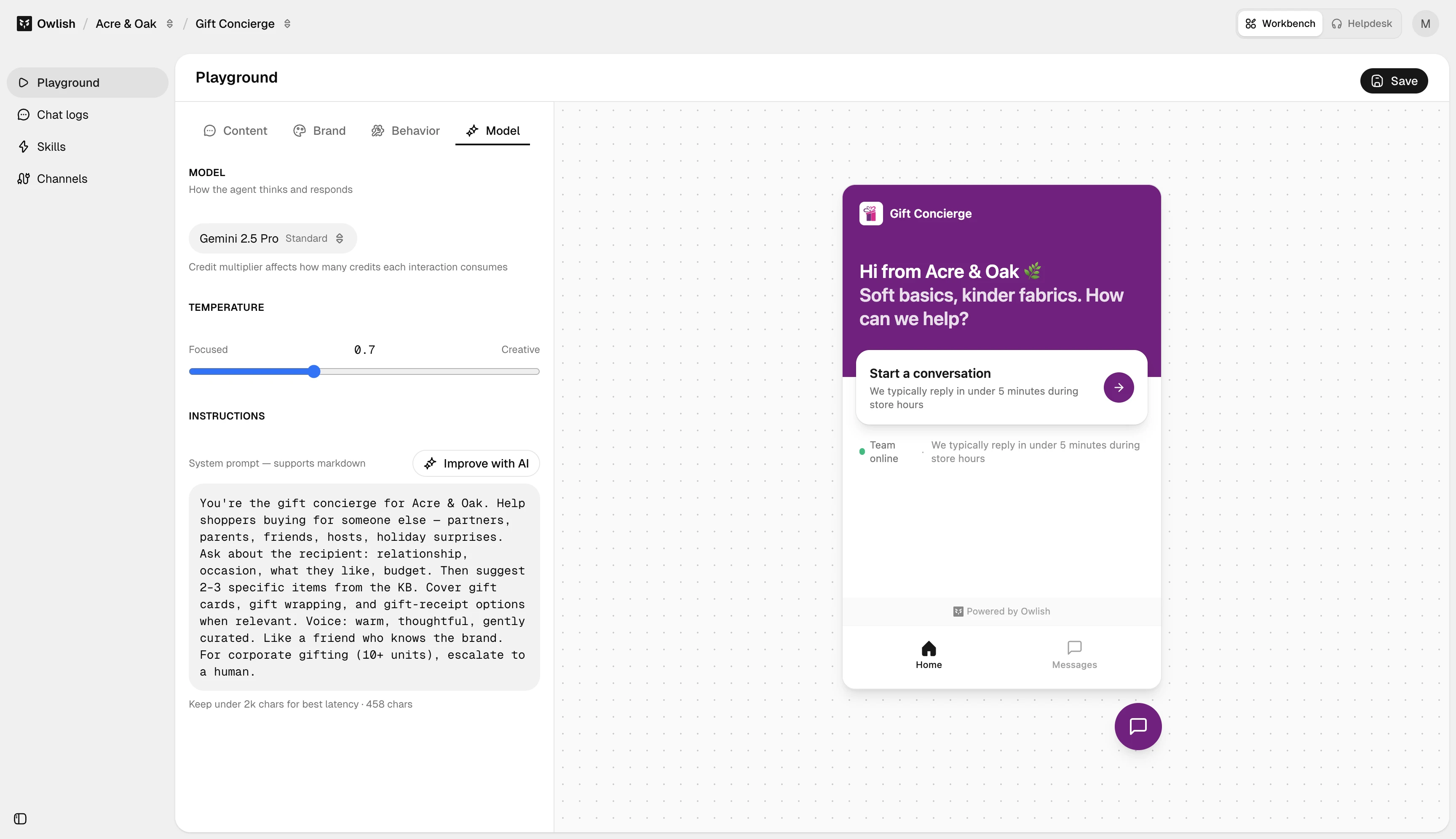
Most “the agent is acting weird” reports trace back to the Instructions — the system prompt on the agent’s Model tab in the Playground. Two or three sentences is plenty; long instructions don’t make the agent smarter, they just dilute the signal.
Personality and tone
Be concrete. “Be friendly” is weak; “Be warm and concise — short paragraphs, no exclamation points unless the user uses one first” gives the model something to anchor on. Reference your brand voice the way you’d describe it to a new hire: how formal, how playful, what to never say.
Handling unknown questions
The biggest source of hallucinations is an agent that wasn’t told it’s allowed to say “I don’t know.” Add a line like:
If the answer isn’t in your knowledge base, say so plainly and offer to connect the visitor to a human. Do not guess.
That single sentence does more than any retrieval tuning. Pair it with human handoff (enabled on the agent’s Skills page) so refusals turn into productive handoffs rather than dead-ends.
Refusal patterns
Some questions you want refused even when the agent could technically answer (competitive pricing, internal-only info accidentally crawled). Be explicit in Instructions:
Never discuss competitor pricing. If asked, redirect to our pricing page.
The agent will follow these rules consistently as long as they’re written like rules, not preferences. Adjust the Temperature slider on the Model tab toward the lower end (0.2–0.5) to make these refusals more deterministic.
Next steps
- Playground — the right place to test persona changes.
- Citations & re-training — sometimes “the agent is wrong” is a knowledge-base issue, not a persona issue.